Welcome to The Responsible AI Audit™ Brief.
Skills4Good AI’s weekly 3-minute audit of AI use in professional practice.
This Week’s Audit
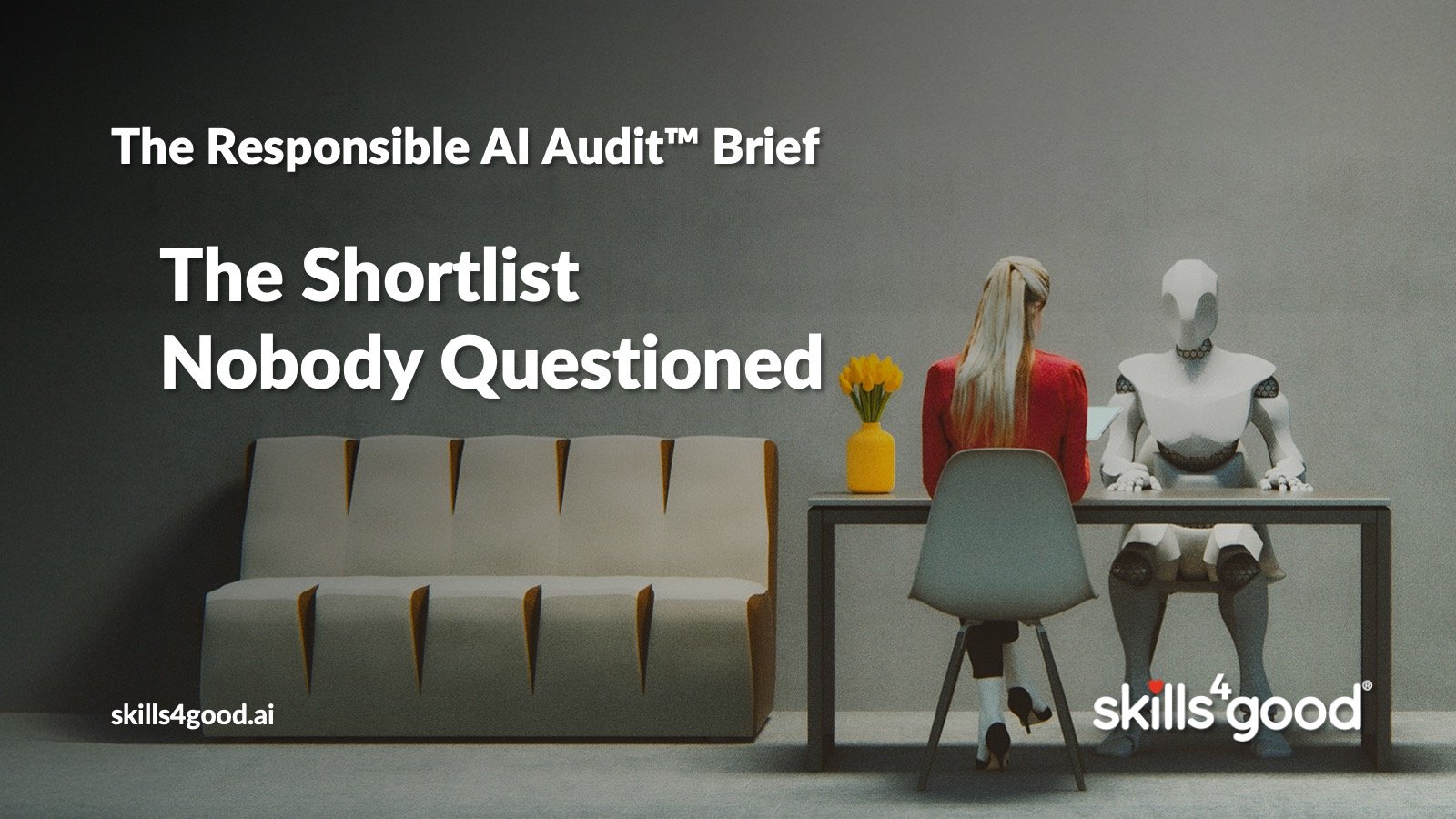
Marcus Webb, executive director of a mid-sized health policy association, needed to fill a Director of Government Relations role. Fifty-two applications arrived over three weeks. He used the association’s AI hiring platform to generate a ranked shortlist, setting three criteria himself: policy experience, stakeholder management, and writing ability.
The platform provided a ranked list of 15 candidates, and Marcus examined the top 10 before reading any resume in full.
Two days later, his board chair forwarded him an email from a colleague she knew personally. The email highlighted a candidate ranked 41st by the AI platform. Twelve years of federal policy experience. Congressional staff background. Published analysis in three major policy journals.
“The AI ranked her 41st,” Marcus said. “She had more federal policy experience than the top three candidates combined.”
He pulled up the AI platform’s scoring breakdown. The AI weighted “government relations” based on the formal title held, years spent in that role, and tenure at institutions it categorized as policy organizations. Candidates who had built equivalent policy careers through advocacy organizations, community coalitions, or nontraditional pathways scored significantly lower. Not because their work was less relevant. Because the AI operationalized “experience” using patterns from historical hiring data.
The shortlist reflected who had already been hired for similar roles. Not who was qualified for this one.
Here’s where professionals get stuck.
Marcus set the criteria himself. He assumed the AI platform applied them neutrally. However, the platform used methods that reflected decades of hiring patterns he had never examined. The shortlist was created, and interview invites were sent out before Marcus reviewed the entire pool of candidates.
His board had expected a diverse pool of candidates, but the interview schedule didn’t reflect that. The problem wasn’t that Marcus was careless.
It was that he had delegated his judgment to the AI platform — what Fortune’s AI Editor Jeremy Kahn calls “moral deskilling” in Mastering AI — before he ever reviewed the full picture.
Biased AI outputs are not a technology problem.
They are a delegated judgment problem.
The judgment that determines a person’s access to economic and social
opportunity is yours — not the platform’s.
Skills4Good AI’s Bias Detection for Professionals CPD course offers the methodology for the 3-minute AI audit below.
The 3-Minute AI Audit
Before you rely on any AI-generated ranking, shortlist, or scoring of candidates, ask yourself:
1. Did I review the criteria I gave the AI the same way I would review a screening rubric written by a human recruiter?
Criteria that appear neutral — such as experience level, institution type, and current title — carry historical bias when an AI assigns weight to them. The word “experience” means something different when a model trained on past hiring data interprets it.
If you would review a human screener's rubric for fairness, apply the same scrutiny to what you asked the AI to optimize for.
2. Did I examine who the AI excluded before I decided who to interview?
Most professionals review the shortlist created by the AI. Fewer examine what was left out and whether there is a pattern in those exclusions.
A shortlist that appears demographically narrow does not prove that qualified candidates are missing. It shows that an AI automated decision has already embedded historical patterns of exclusion — and that human judgment must come first before acting on that result.
3. Could I explain this ranking to my board, DEI committee, or the candidates who were not interviewed?
If the answer depends on the AI generating the ranking, you've recognized the AI bias risk. Your organization’s proper hiring responsibilities do not shift to the AI platform that created the shortlist.
AI accountability remains with you for every AI output you use in a professional decision.
These three questions expose the AI bias risks associated with the criteria you set and the assumptions the AI makes to implement them.
Biased AI outputs are not a technology problem. They are a delegated judgment problem.
And no professional accountability shifts to the platform when the output determines a person’s access to economic and social opportunity.
The Standard in Action
This is AI Bias. It shows up in hiring decisions, loan approvals, university admissions, and credit applications — anywhere an AI-generated ranking influences decisions that impact a person’s access to economic and social opportunities.
The Responsible AI Audit™ Standard is designed to detect it before it reaches your board, your members, or the candidates and members. Or before it affects the candidates your organization never interviewed.
We teach this methodology to professionals who want a structured, defensible AI audit process.
The AI Risk Detection Series for Professionals covers all four failure modes. Course 1 is available now. The full Series launches in Q2 2026.
Responsible AI Audit™ CPD Courses for Professionals
See the Course
If you work with colleagues who use AI in hiring or operational decisions, forward this to them.
Next week: Reasoning Gap in financial analysis. What happens when AI produces a confident conclusion from the wrong set of assumptions?
Till next week’s AI audit,
Josephine Yam, JD, LLM, MA Phil (AI Ethics)
CEO & Co-Founder, Skills4Good AI
AI Lawyer | AI Ethicist | TEDx Speaker